

By Belvia Editorial Team · Updated 12 May 2026
Choosing the right phone case in 2026 has become surprisingly difficult. The UK market has hundreds of options across price points from £3 to £80, materials from silicone to vegan leather, and styles from invisible-thin to dual-layer tough. This guide cuts through the noise and gives you a framework to evaluate any phone case on the five things that actually matter: fit, protection, materials, style, and longevity. By the end you will know exactly what to look for, what to ignore, and what your money should be buying you.

The Five Things That Actually Matter
Forget the marketing. Every phone case decision in 2026 comes down to five evaluation criteria. Get these right and the case will last, fit properly, look the way you want it to, and protect your phone. Get them wrong and you will be back on the buy page in three months.
- Fit. Precise cutouts, accurate button feel, snug shell that does not flex when squeezed.
- Protection. Drop-rated construction matched to how you actually use your phone.
- Materials. Polycarbonate, TPU, silicone, vegan leather, or tempered glass - each behaves differently over twelve months of daily use.
- Style. Colourway, print, finish, and silhouette that matches your aesthetic and your wardrobe.
- Longevity. Prints that do not peel, plastics that do not yellow, fit that does not loosen, hardware that does not corrode.
Every section below walks you through one of these criteria with the exact questions to ask before you add to basket. If you already know which iPhone or Samsung Galaxy model you have, jump straight to the phone cases collection or browse the complete phone case buying guide for 2026 for the deeper material reference.
1. Fit: The Single Most Important Factor
Fit is the criterion most buyers ignore and then regret. A poorly-fitting case rattles when you tap the screen, the buttons feel mushy, the camera cutout sits too high or too low, and the case eventually loosens to the point where it slides off in your bag. Before you spend anything, check three things on the product page.

The cutout test
Look at the product images. Are the camera, charging port, and button cutouts precision-cut to the exact dimensions of your phone, or are they oversized and generic? Cases moulded for a "family" of phones (for example, one cutout that fits both an iPhone 16 and iPhone 16 Pro) almost always fit one model badly. Belvia London cuts every case to the exact device dimensions, which is why the cutouts read flush on every model in the phone cases collection.
The bezel test
A good case has a raised lip around the screen and a raised lip around the camera module. The screen lip protects the glass when you place the phone face-down on a café table. The camera lip protects the lens when you place the phone face-up. If the product photos show a flat case with no raised edges, the protection level is below what you should accept at any price.
The shell rigidity test
Single-layer silicone or TPU cases are flexible and slim but offer no rigid impact absorption. Dual-layer tough cases combine a polycarbonate outer shell with a TPU inner bumper, which spreads impact across the case rather than transferring it to the phone. If the product description does not state the construction explicitly, assume it is single-layer.
2. Protection: Match the Case to How You Actually Use Your Phone
Protection is not a single number. A "drop-tested to 3 metres" claim is meaningless if the test was done on carpet at one specific angle. The honest question is: how do you use your phone, and what protection level matches that use?
- Desk, handbag, occasional pocket. A slim silicone or vegan leather case with raised bezels is enough. You are protecting against scratches and the occasional drop from table height.
- School run, commute, gym, kids around. A dual-layer tough case with polycarbonate shell and TPU bumper. This is the most common UK use case and where most £20 to £30 cases earn their price.
- Outdoor, building site, sports, frequent drops onto hard floors. A heavy-duty case with reinforced corners, raised bezels, and ideally a built-in screen protector. These tend to start at £30 and run to £70.
Shop the phone case collection
What drop ratings actually mean
"Military-grade" usually refers to MIL-STD-810G, a US Department of Defence standard that includes a drop test from 1.22 metres on each of the six faces and eight corners. It is a useful baseline but does not mean indestructible. "Drop tested to 3 metres" is a marketing claim with no fixed methodology. Treat any number as a maximum, not a guarantee.
Why dual-layer construction matters
A single-layer hard case transfers most of the impact energy straight to the phone. A single-layer soft case absorbs energy but flexes too much to protect the screen edge. Dual-layer construction (rigid polycarbonate outer, flexible TPU inner) gets the best of both: the outer disperses impact across the case body, the inner cushions the phone. This is the construction Belvia London uses on the tough range at £25.

3. Materials: What Each One Does Over Twelve Months
Materials are where cheap cases reveal themselves quickly. The same case can look identical on day one and fall apart in six months if the materials are wrong. Here is what each material actually does over a year of daily use.
- Polycarbonate. Hard, transparent or printable, scratch-resistant, lightweight. The standard outer shell on most quality cases. Does not yellow if the formulation is good. Yellows badly if it is cheap.
- TPU (thermoplastic polyurethane). Flexible, shock-absorbing, grippy. Used on bumpers, inner layers, and slim cases. Quality TPU stays clear for two-plus years. Cheap TPU yellows in four to six weeks.
- Silicone. Soft, grippy, warm to the touch. Excellent everyday feel. Attracts lint and dust. Loses snap fit after about a year.
- Vegan leather. A PU coating over a backing layer. Looks premium, ages with character if the quality is good. Cheap vegan leather peels at the edges within months.
- Tempered glass back. Premium feel, scratch-resistant, mirrors the phone glass aesthetic. Can shatter if dropped on a corner. Worth it for the look, but pair with a tough bumper.
How to read a materials description
If a product page only says "high-quality plastic" or "premium materials", that is a red flag. A good product description will name the specific construction: "dual-layer polycarbonate shell with TPU bumper", "matte finish PU vegan leather over rigid backing", "soft-touch silicone with raised TPU bezel". Specificity is honesty.
4. Style: How to Match the Case to Your Aesthetic
Style is personal, but it is also a category you can shop systematically. Belvia London groups every case into one of five aesthetic families. Identify yours and the choice gets dramatically easier.
- Clean and minimal. Clear cases, soft pastels, single tones, simple silhouettes. Pairs with most wardrobes. See the black phone case guide for the most flexible base.
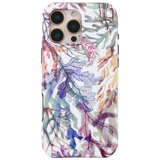
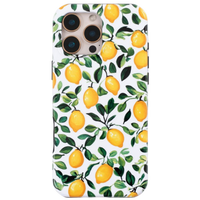
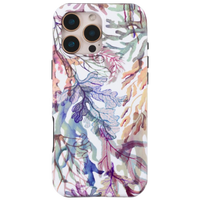
- Soft and romantic. Florals, pearl finishes, wavy edges, blush and lilac palettes. See the pink phone case guide and the pearl phone case guide.
- Coastal and warm-neutral. Mocha, sand, sage, off-white. Reads as quiet luxury without being plain.
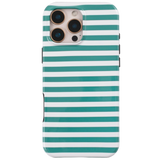
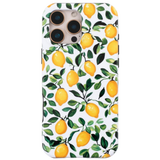
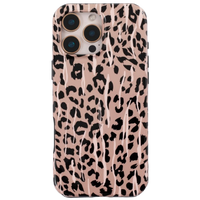
- Bold and pattern-led. Stripes, retro florals, abstract prints. Statement pieces that anchor an outfit.
- Editorial and considered. Tonal layering, matte finishes, fashion-led colour stories. The aesthetic phone cases edit sits here.
The one-question shortcut
Hold up your most-worn coat. Does the phone case you are about to buy sit comfortably next to it in the photo? If yes, you have a winner. If no, the case will sit in a drawer in two months.

5. Longevity: The Twelve-Month Test
The price-per-month calculation is more useful than the sticker price. A £15 case that lasts three months costs £5 per month. A £25 case that lasts eighteen months costs £1.40 per month. Longevity comes down to four engineering details.
- Print bonding. UV-bonded or sublimation prints fuse the design to the material. Cheap stickers and decals peel within weeks.
- Yellowing resistance. Good polycarbonate and TPU formulations stay clear for years. Cheap ones yellow within a month, especially on the clear sections.
- Snap retention. The plastic memory that keeps the case snug on the phone. Quality cases retain snap fit for the life of the phone. Cheap cases loosen within months.
- MagSafe magnet strength. If the case is MagSafe-compatible, the magnet ring needs to retain holding force after hundreds of attach-detach cycles. Cheap magnets weaken within weeks.
Warranty and returns
A good UK phone case retailer will offer hassle-free returns within 30 days on unused cases. Belvia London ships from a UK warehouse, offers free UK delivery on orders over £25, and processes returns through the contact page. The customer covers the return postage, which is why we use "hassle-free returns" rather than "free returns" - the wording matters because it is honest.
The Quick Decision Framework
If you have read this far and still cannot decide, use this three-question framework.
- How much do you drop your phone? Rarely - go slim. Sometimes - go dual-layer tough. Often - go heavy-duty.
- What is your aesthetic? Match to one of the five families above.
- What is your device? iPhone 17 Pro Max, iPhone 16, iPhone 15, Samsung Galaxy S25, or older. Browse the device-specific collection to filter automatically.
The iPhone 17 Pro Max cases collection, the iPhone 16 Pro Max cases collection, the iPhone 15 cases collection, and the Samsung Galaxy S25 cases collection are the best starting points for the most common 2026 UK phone models.
Browse the full phone case collection
Frequently Asked Questions
What is the most important factor when choosing a phone case?
Fit. A case with precise cutouts, raised bezels around the screen and camera, and a rigid shell will outperform a cheaper case at every price point. Without proper fit, even premium materials will fail you within months.
Are expensive phone cases worth it?
Sometimes. The sweet spot for most UK buyers is the £20 to £30 band, which gets you dual-layer construction, raised bezels, UV-bonded prints, and a case that lasts twelve months or more. Above £40 you are mostly paying for brand positioning, not engineering.
How do I know if a phone case is MagSafe compatible?
The product description will state it explicitly and the case will have a magnet ring built into the back. If the description only says "wireless charging compatible", that is not the same as MagSafe - true MagSafe requires the ring magnet array, not just a thin enough case for inductive charging to work through.
What is the difference between a slim case and a tough case?
A slim case is a single-layer shell (silicone, TPU, vegan leather, or thin polycarbonate) that adds about 1mm of thickness. A tough case is a dual-layer construction with polycarbonate shell and TPU bumper, adding about 2.5mm of thickness and significantly more drop protection.
How long should a phone case last?
A quality case at £20 to £30 should last at least twelve months of daily use without yellowing, loosening, or print degradation. If you change phones annually, one good case will see you through to the next device.
Do Belvia London cases come with a warranty?
Yes. Hassle-free returns within 30 days on unused cases, processed through the contact page. The UK warehouse means delivery is two to three working days and returns are straightforward. Free UK delivery applies on orders over £25.